

 英语
英语 中文简体
中文简体



1. Why Demand-Side Flexibility Is Moving into Practice
Demand-side flexibility is moving beyond pilot projects and becoming part of practical grid operation, energy management and market participation.
At The smarter E Europe on 24 June 2026, demand-side flexibility appeared across several official sessions, including a guided tour on technical implementation and commercial use, a utility peer exchange focused on congestion management, and a session presenting real-world flexible-demand projects. The program covered industrial loads, battery storage, generation assets, peak shaving, ancillary services, flexibility markets and scalable connectivity.
This growing attention reflects several changes in the electricity system:
- Increasing renewable-energy variability
- Local transformer, feeder and grid congestion
- Electrification of industrial processes
- Expansion of EV charging and heat-pump loads
- Wider deployment of battery energy storage
- Growing use of distributed generation and prosumer assets
Demand-side flexibility does not eliminate the need for grid reinforcement. However, it can help manage the timing, location and magnitude of electrical demand when suitable assets, control systems and market arrangements are available.
Before a C&I site, load or behind-the-meter asset can be treated as a usable flexibility resource, an important question must be answered:
How will its baseline, response and actual performance be measured, reported and verified?
Reliable field-level measurement is one of the foundations for identifying, activating and verifying flexible demand.
2. What Makes a C&I Site or Asset Flexible?
A flexible C&I site can modify its net power profile through controllable loads, storage systems, on-site generation or combinations of these resources, within defined technical and operational limits.
Examples may include:
- Production loads that can be shifted to another time
- Loads that can be temporarily reduced
- Non-critical processes that can be interrupted for a limited period
- HVAC and refrigeration systems with thermal flexibility
- EV charging with adjustable charging schedules
- Battery systems that can charge or discharge
- Large motors and industrial process equipment
- Hybrid systems combining grid supply, PV, storage and backup generation
Different assets provide different forms of flexibility.
A production process may be shiftable but not interruptible. A cooling system may reduce power temporarily but must remain within temperature limits. A battery may respond quickly but is constrained by state of charge, power rating and operating strategy. On-site generation may reduce net grid demand without changing the underlying facility load.
The fact that a site or asset is technically controllable does not automatically mean it qualifies for a grid service, demand-response program or flexibility market.
A usable flexibility capability may also require:
- Reliable measurement
- A defined baseline
- Communication connectivity
- A control interface
- Response-time requirements
- Operational availability
- Measurement and verification
- Contractual or market eligibility
- Settlement rules where applicable
3. From Energy Consumption Data to Flexibility Data
Traditional energy monitoring and flexibility measurement serve different purposes.
|
Traditional energy monitoring |
Flexibility applications may require |
|
Monthly or cumulative kWh |
Time-based or interval load profiles |
|
Total energy consumption |
Power change before, during and after an event |
|
Billing demand |
Verified reducible or shiftable capacity |
|
One incoming meter |
Site, feeder, subsystem or asset-level data |
|
Manual data collection |
Automated communication and time alignment |
|
Total facility load |
Separation or attribution of controllable and non-controllable demand |
Flexibility is evaluated through changes in power over time, not only through total energy consumption.
A monthly total may show how much electricity a facility used, but it does not show:
- When the highest demand occurred
- How quickly demand changed
- Which asset or process caused the change
- Whether a reduction resulted from control action or normal operational variation
- How long the response was maintained
- Whether demand rebounded after the event
For this reason, flexibility projects generally require more granular and better-structured data than basic monthly billing analysis.
In the European Union, transmission system operators, distribution system operators and relevant market participants, including independent aggregators, may use dedicated measurement-device data, with the final customer’s consent, for the observability and settlement of demand response, energy storage and other flexibility services.
Where a final customer does not have a smart meter, or where the smart meter does not provide the data required for the relevant flexibility service, transmission and distribution system operators are required to accept available dedicated measurement-device data for settlement, subject to applicable national validation, data-quality, interoperability, privacy and program requirements.
This does not mean that every private sub-meter is automatically suitable for settlement. Acceptance still depends on customer consent, data quality, validation rules, interoperability and the requirements of the applicable program.
4. Core Metering Data Categories
The required data set depends on the asset, project objective, contractual rules and verification method. Not every flexibility project requires every parameter.
Depending on the selected meter and architecture, useful data may include:
- Active power
- Cumulative import energy
- Export energy where relevant
- Interval energy
- Maximum demand
- Voltage
- Current
- Power factor
- Reactive power
- Frequency
- Timestamped readings
- Device and communication status where available
- Alarm, status or event information where supported
- Import and export direction
For three-phase industrial systems, phase-level measurements may also be useful where supported by the selected model.
The metering architecture should be designed around the actual flexibility use case. A project that only monitors site peak demand may have different requirements from one that verifies a five-minute demand-response event or measures bidirectional battery operation.
4.1 What a Flexibility Data Record Should Report
Measuring the correct electrical parameter is only part of the requirement. The reported record should also identify the context, timing and validity of the data.
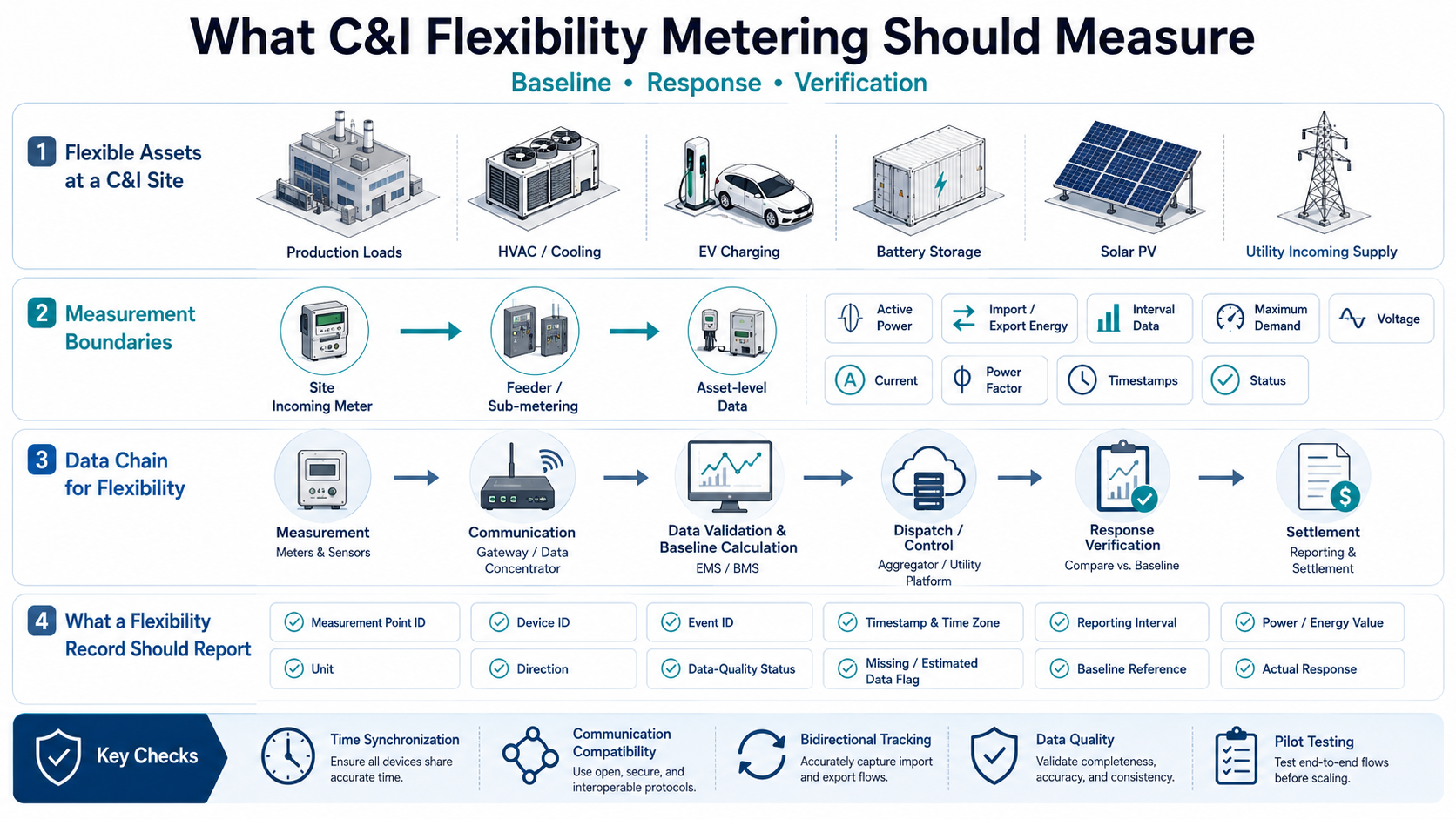
Depending on the project and verification rules, a flexibility data record may include:
- Measurement-point or asset identifier
- Meter or device identifier
- Event or activation identifier
- Timestamp and applicable time zone
- Measurement or reporting interval
- Active-power or interval-energy value
- Unit of measurement
- Import/export or charge/discharge direction
- Data-quality or validity status
- Missing, substituted or estimated-data indication
- CT/PT ratio or scaling information where applicable
- Baseline-method or baseline-version reference
- Actual response compared with the applicable baseline
- Relevant firmware or register-map version
Near-real-time operational data and validated settlement data should not automatically be treated as equivalent.
The applicable program should define how data is:
- Validated
- Corrected
- Retained
- Recovered after communication interruptions
- Approved for verification or settlement
5. Baseline, Response and Verification
Baseline, response and verification form the commercial and technical core of demand-side flexibility.
5.1 Baseline
The baseline represents the expected electricity demand if no flexibility event had occurred.
A baseline may be based on:
- Historical interval data
- Comparable operating days
- Production schedules
- Weather or temperature conditions
- Occupancy
- Equipment availability
- Agreed market or aggregator methodology
The applicable baseline method is usually defined by the flexibility program, aggregator, system operator, contract or settlement arrangement.
The energy meter provides measured data. It does not normally define or calculate the complete baseline methodology by itself.
5.2 Response
The response is the measured change in power or energy during the requested event.
It may involve:
- Reducing a load
- Delaying a load
- Increasing consumption during surplus generation
- Discharging battery storage
- Reducing EV charging power
- Shifting an industrial process
The response must be evaluated against the correct measurement boundary, baseline and time window.
5.3 Verification
Verification determines whether the promised response occurred and whether it met the required magnitude, timing and duration.
A verification process may need to confirm:
- Event start and end time
- Baseline value
- Actual measured power
- Achieved reduction or increase
- Response delay
- Response duration
- Recovery or rebound behavior
- Missing-data treatment
- Meter and timestamp validity
- Data-quality status
- Applicable correction or substitution rules
Data quality directly affects settlement, performance assessment and dispute resolution.
6. Where Should C&I Facilities Install Meters?
A single incoming meter may not provide enough detail to identify which assets contribute flexibility.
Depending on the facility, relevant measurement points may include:
- Utility incoming supply
- Main transformer or main distribution board
- Production lines
- Large motors and process equipment
- HVAC and cooling systems
- Refrigeration loads
- EV charging infrastructure
- Battery energy storage systems
- PV inverter output
- Critical loads
- Non-critical loads
- Tenant or departmental circuits
Where asset-level attribution or verification is required, the metering architecture should distinguish controllable resources from non-controllable base load.
Separate physical meters are not necessarily required for every asset if the approved architecture can provide sufficiently accurate, time-aligned and verifiable data through other devices or control systems.
Possible data sources may include:
- Dedicated energy meters
- Equipment controllers
- BMS or EMS data
- Charger or PCS data
- Approved allocation methods
- Validated engineering or allocation models, where accepted by the applicable program or verification methodology
The selected measurement points should reflect the required electrical and operational boundary. Site-level net demand, feeder-level consumption and individual equipment behavior answer different questions.
7. Meter, EMS, Aggregator and System-Operator Responsibilities
Demand-side flexibility is a multi-system process. The meter is an important data source, but it is not the complete flexibility platform.
|
System or participant |
Primary responsibility |
|
Energy meter |
Measures and outputs supported electrical values |
|
Gateway or data concentrator |
Collects, converts and forwards meter data |
|
EMS or BMS |
Analyzes site conditions and may execute local control |
|
Asset controller |
Controls equipment, charging power, storage or process loads |
|
Aggregator |
Combines multiple assets and may participate in programs or markets |
|
Utility, system operator or program administrator |
Defines applicable technical, operational or program requirements |
|
Settlement system |
Applies validation, verification and settlement rules |
A typical process may follow:
Measurement → communication → data validation and baseline calculation → dispatch or control → response verification → settlement
The meter supports the measurement layer. It does not independently determine the baseline, dispatch the asset, bid flexibility into a market or calculate final settlement.
Depending on the program, response requests or operating instructions may be issued or coordinated by:
- A utility
- A transmission system operator
- A distribution system operator
- An aggregator
- A flexibility platform
- A program administrator
8. Communication and Time Synchronization
Reliable communication is important when meter data is used for flexibility analysis, control support or verification.
Depending on the selected model and project architecture, field-level integration may use:
- RS485
- Modbus RTU over RS485
- Ethernet
- Modbus TCP where supported
- Pulse output for limited energy-counting applications
- Project-specific interfaces
Pulse outputs generally provide less contextual information than register-based digital communication and may not be sufficient on their own for time-aligned flexibility verification.
Pulse outputs may provide cumulative energy information, but they do not normally provide the same level of data context as digital registers, such as:
- Timestamped active-power values
- Reactive-power values
- Device status
- Event identifiers
- Data-quality flags
- Register-level diagnostics
Supporting the same protocol does not automatically guarantee compatibility.
The project should confirm:
- Physical interface
- Protocol variant
- Device addressing
- Register map
- Data types
- Byte and word order
- Units and scaling
- Import and export conventions
- Internal measurement interval
- Register refresh rate
- Controller polling frequency
- Gateway capacity
- Timeout and retry behavior
- Timestamp source
- Clock accuracy
- Drift tolerance
- Time-synchronization method
- Missing-data handling
- Offline storage and recovery
- Firmware and register-map version
- Authentication and access-control requirements
Fast polling is not the same as settlement-grade interval data.
A controller may poll a meter every second, but the applicable flexibility program may require validated five-minute, fifteen-minute or event-based records produced according to a defined method. The required interval should be confirmed for the specific project.
9. How Storage and EV Charging Expand Flexibility
9.1 Battery Energy Storage Systems
Battery storage can modify a site’s net load by charging or discharging.
For flexibility applications, the project may need to distinguish between:
- Grid import
- Battery charging energy
- Battery discharge energy
- PCS input and output
- Auxiliary consumption
- Site net demand at the point of interconnection
A reduction in site import may be caused by battery discharge, load reduction, PV generation or a combination of these factors. The measurement architecture should make the relevant contribution traceable.
9.2 EV Charging
EV charging can provide flexibility when charging schedules and power levels can be adjusted within user and operational constraints.
Examples include:
- Moving fleet charging to off-peak periods
- Reducing charging power during a congestion event
- Coordinating multiple chargers to limit site peak demand
- Responding to dynamic tariff signals
- Increasing charging during periods of high renewable generation
- Tracking import and export in bidirectional charging architectures
Vehicle availability, required departure state of charge, charger power, user requirements and control-system capabilities all affect usable flexibility.
Meter data supports measurement and verification, while charging controllers, EMS platforms or fleet-management systems implement the charging strategy.
10. Buyer Checklist for Flexibility-Ready Metering
Before selecting metering hardware, confirm the following:
|
Selection area |
What to confirm |
|
Measurement point |
Incoming supply, feeder, asset or equipment boundary |
|
Controllable asset |
Which load, storage system or charger can respond |
|
Required parameters |
Power, energy, demand, voltage, current, power factor or status |
|
Data interval |
Required measurement and reporting interval |
|
Timestamp source |
Meter, gateway, controller or platform |
|
Time accuracy |
Clock accuracy, drift tolerance and synchronization method |
|
Accuracy requirement |
Meter accuracy and complete measurement-chain uncertainty |
|
Import/export |
Whether bidirectional tracking is required |
|
Communication |
Physical interface and protocol |
|
Register map |
Addresses, units, scaling and data types |
|
Gateway |
Device capacity, polling rate and data buffering |
|
Data retention |
Storage duration and retrieval method |
|
Missing data |
Substitution, recovery and validation rules |
|
Data-quality status |
Valid, missing, substituted, estimated or corrected-data flags |
|
EMS integration |
Controller, gateway and software compatibility |
|
Baseline method |
Defined by project, aggregator or program rules |
|
Verification method |
How performance will be measured and approved |
|
Legal or program acceptance |
Whether the meter and data source are accepted for the intended use |
|
Cybersecurity and access |
Authentication, access control, firmware management and data-transfer security |
|
Pilot testing |
Meter, gateway, EMS and asset-control validation |
Accuracy should not be assessed only by the meter class.
The complete measurement chain may also include:
- CTs
- PTs
- Shunts
- Compatible current sensors
- Wiring
- Scaling
- Time base
- Data conversion
- Gateway processing
The meter should be selected only after the measurement boundary, controllable asset, data use and verification objective have been defined.
11. How YTL Can Support Initial Meter Evaluation
Zhejiang Yongtailong Electronic Co., Ltd. (YTL) provides energy-metering products for selected C&I, industrial, EV-charging, PV, storage and building-energy applications, depending on the selected model and project architecture.
Available options may include:
- DIN-rail energy meters
- Panel-mounted meters
- Multi-function energy meters
- CT-operated meters
- AC energy meters
- Selected DC metering products
- Communication-enabled models
Depending on the selected model and project requirements, YTL can support:
- Initial meter-model selection
- Voltage and current-range review
- Review of customer-proposed CT ratios, secondary inputs and meter-side measurement requirements
- Initial technical discussion of customer-proposed measurement points
- Communication-option confirmation
- Register-map and data-format review
- Sample testing support
- Meter-to-gateway or controller integration review
- Project-specific technical discussion
Product capabilities vary by model, hardware, firmware, current-sensing arrangement, communication interface and register-map version.
Communication capability, protocol implementation, accuracy requirements and platform compatibility should be confirmed for the selected model and project specification.
YTL supports the field-level measurement and data-acquisition layer. Baseline methodology, demand-response dispatch, asset control, aggregator participation, flexibility-program qualification, market bidding and final settlement remain the responsibilities of the relevant project developers, EMS providers, aggregators, utilities, system operators and other program participants.
12. Conclusion
Demand-side flexibility depends on more than the ability to control an electrical load or behind-the-meter asset.
It requires a complete chain of:
Measurement → communication → data validation and baseline calculation → dispatch or control → response verification → settlement
For C&I projects, the metering and data architecture should make relevant assets visible, provide suitable time-based data and support consistent integration with gateways, EMS platforms and verification processes.
Reliable energy measurement does not create flexibility by itself. It provides the data foundation required to identify, activate, report and verify flexible demand.
References
- The smarter E Europe, “Demand-Side Flexibility,” June 24, 2026.
- The smarter E Europe, “Utility Peer Exchange: Using Demand-Side Flexibility to Relieve Congestion and Serve Customer Demand,” June 24, 2026.
- The smarter E Europe, “Demand-Side Flexibility in Action: Best Practices from the Flexible Demand Management Industry,” June 24, 2026.
- The smarter E Europe, “Prosumer, Flexibility & Energy Communities,” June 24, 2026.
- Regulation (EU) 2024/1747 of the European Parliament and of the Council of 13 June 2024 amending Regulations (EU) 2019/942 and (EU) 2019/943 as regards improving the Union’s electricity market design, Article 7b, “Dedicated measurement device.”
- Commission Implementing Regulation (EU) 2023/1162 of 6 June 2023 on interoperability requirements and non-discriminatory and transparent procedures for access to metering and consumption data.
Taken together, the June 24 program indicates a practical focus on aggregating, automating, controlling and commercially using flexibility from industrial loads, batteries, EVs, generation assets and other distributed resources.